Managed IT vs. Break/Fix: Which Fits Your NYC Business?
Every business owner has had this moment. A server goes down, an inbox stops syncing, or a laptop won't boot on the morning of a big meeting.
How that gets fixed, and who pays for it, comes down to one decision made long before the problem ever happened: break/fix or managed IT.
Both models can keep a business running. Only one is built to stop the fire before it starts.
Quick Answer
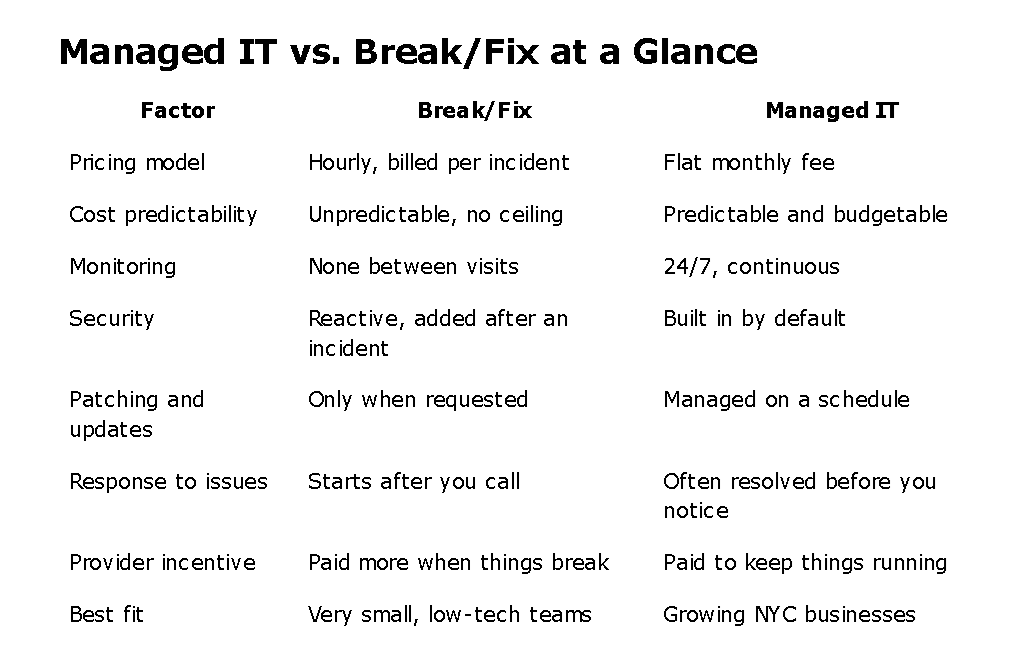
Break/fix charges you only when something breaks, with no ongoing monitoring in between.
Managed IT charges a flat monthly fee for continuous monitoring, maintenance, and security.
Break/fix can work for very small teams with minimal tech dependence and high tolerance for downtime.
Most growing NYC businesses save money with managed IT once downtime and security risk are factored in.
The real question is not which costs less per hour. It is who carries the risk when something goes wrong.
Why It Matters in 2026
NYC businesses run on systems that were optional a decade ago and are now essential: cloud file storage, Microsoft 365, VoIP phones, and remote access for hybrid teams across Manhattan, Brooklyn, and beyond.
That dependence raises the cost of every outage. A break/fix call that once meant a slow afternoon can now mean a stalled sales team, a missed client deadline, or a security gap that goes unnoticed for weeks.
The decision between break/fix and managed IT is really a decision about how much risk your business is willing to carry quietly in the background.
Risks, Threats, and Compliance Issues
What break/fix does not cover
Continuous monitoring for suspicious activity or early signs of failure
Patch management, which leaves known vulnerabilities open longer than they should be
Documented security practices that insurers and larger clients increasingly ask to see
Where the risk shows up
Break/fix providers are not on your network between visits. A compromised account or a failing hard drive can sit undetected until it becomes an emergency, and by then the cost is no longer a simple repair.
Managed IT Solutions Built for Growing Businesses
Managed IT flips the incentive. Instead of billing more when something breaks, a managed provider is paid to keep things from breaking in the first place.
Round-the-clock monitoring that catches problems before employees notice them
Security is built into the plan by default, not sold separately after an incident
One flat monthly rate that covers support, patching, and strategic planning
A team that already knows your systems, instead of starting from zero on every call
Explore managed IT services built around predictable pricing and proactive support.
Tools, Frameworks, and Best Practices
Remote monitoring and management tools that flag issues in real time
Multi-factor authentication and managed endpoint protection as standard, not add-ons
Documented backup and disaster recovery testing on a regular schedule
Quarterly technology reviews tied to business goals, not just ticket counts
The Cost of Ignoring the Issue
Break/fix often looks cheaper on paper because there is no invoice when nothing breaks. That math falls apart the moment something serious does.
The numbers are sobering. In the 2025 Calyptix/ITIC SMB Security Survey, 37% of small and mid-sized businesses said a single hour of downtime costs them between $1,000 and $5,000, and for 8% the cost tops $25,000 an hour. A single major outage or ransomware event can erase years of apparent break/fix savings in days, and unlike a flat managed IT fee, break/fix costs have no ceiling.
The businesses that stay on break/fix longest are usually the ones that have not yet had their one bad incident.
How to Decide: A Practical Framework
You do not need a consultant to pressure-test this decision. Four questions get you most of the way there.
Count your dependence. List how many devices, cloud tools, and remote users your business actually relies on today. The longer the list, the more a single failure ripples outward.
Price an hour of downtime. Put a real number on what one hour offline costs you in lost revenue and missed deadlines. If that number makes you wince, reactive support is already too risky.
Pilot your critical systems. Move your most important systems onto a managed, monitored plan first, rather than waiting for the next failure to force the decision.
Review quarterly. Revisit the plan every few months so your IT spending tracks how the business is actually growing, not how it looked a year ago.
Why Outsourcing IT Makes Sense
Very few small businesses can justify a full-time IT department. Managed IT gives them access to enterprise-level monitoring, security, and strategic planning at a shared cost, spread across a flat monthly rate.
It also removes the guesswork. Instead of hoping nothing breaks before the next scheduled visit, a managed partner is actively watching, patching, and improving the environment every day.
Learn more about how outsourced IT support fits small to mid-sized NYC businesses.
Real-World Use Cases
Professional services firms. Consistent uptime for client meetings, billing systems, and document access, without waiting on a break/fix callback.
Retail and small SMBs. Point-of-sale and payment systems that stay online during peak hours, backed by monitoring instead of a reactive service call.
Growing companies adding staff. Fast, standardized onboarding for new employees instead of ad hoc setups that create security gaps.
Businesses handling client or financial data. Documented security controls that satisfy vendor questionnaires, insurance requirements, and client expectations.
Frequently Asked Questions
Is break/fix ever the right choice? For a very small team with minimal technology dependence and a high tolerance for downtime, break/fix can be sufficient. Most growing businesses outgrow it quickly.
Why does managed IT cost more per month than break/fix? It does not always. Break/fix looks cheaper until an outage or security incident hits, at which point managed IT is usually the less expensive option over time.
Does managed IT include cybersecurity? Yes, in a properly built plan. Security should be part of the core service, not billed separately after something goes wrong.
How long does it take to switch from break/fix to managed IT? Most transitions take a few weeks, including an initial assessment and a phased rollout that avoids disrupting daily operations.
Will managed IT work with our existing systems? In most cases, yes. A good provider assesses your current environment first and builds the plan around what you already have.
What is the biggest sign we have outgrown break/fix? Frequent IT issues, growing headcount, or a single outage that visibly hurt revenue are all signs the reactive model no longer fits.
The Bottom Line
Break/fix is not a bad choice. It is simply built for a smaller, simpler kind of business than most NYC companies have become.
Managed IT trades an unpredictable gamble for a predictable partnership, one where your provider has a direct stake in keeping your systems running.
Setton Consulting offers flat-rate managed IT built around real NYC business needs, serving companies across Manhattan, Brooklyn, and the wider metro with direct access to a team that already knows your setup.
Schedule a call with Setton Consulting to find out which model actually fits your business, or call us at 855-699-7219.