
Tech Insights
Stay ahead in the dynamic world of technology with our tailored solutions and proactive support.
Agentic AI: What It Means When AI Stops Assisting and Starts Acting
For the past couple of years, most businesses have used AI as a helper. You ask it a question, it gives you an answer. You paste in some text, it rewrites it. You describe a problem, it suggests a solution. The human drives every step. That dynamic is starting to change in a significant way, and if you run a business, it is worth understanding what comes next.
Quick Answer
Agentic AI is software that does not just respond to prompts but can take actions and complete multi-step tasks on your behalf.
- Traditional AI assists: you ask, it answers
- Agentic AI acts: it can carry out tasks across steps and systems
- This unlocks real automation but also new oversight needs
- Clear guardrails and human review matter more as AI takes action
- Start with low-risk tasks before handing over anything critical
What Is Agentic AI?
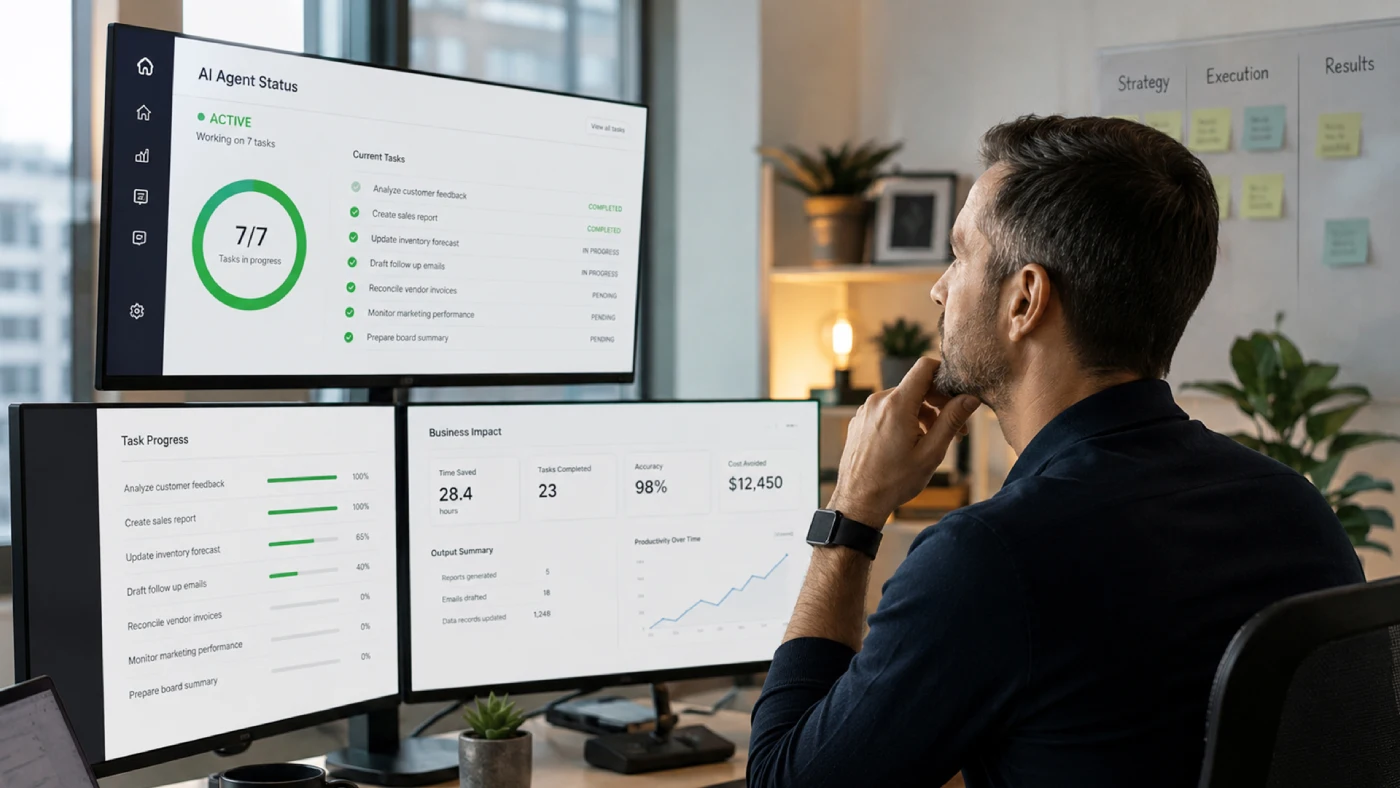
Agentic AI refers to AI systems that can take action independently rather than just responding to prompts. Instead of waiting to be asked, you give an agentic AI a goal and it plans the steps, executes them, monitors the results, and adjusts along the way without needing you to direct each individual move.
Think of the difference between a calculator and a capable employee. A calculator gives you an answer when you put in the numbers. An employee understands what outcome you want, figures out what needs to happen, and gets it done. Agentic AI is moving in the direction of the second model.
Practical examples already exist. An agentic AI might receive a customer inquiry, look up the account history, draft a response, check it against your policies, send it, and log the interaction without any human touchpoint in the middle.
Why This Matters for Small and Mid-Sized Businesses
On the opportunity side, agentic AI can handle multi-step processes that currently require real human time. Scheduling complex projects, processing and routing customer inquiries, generating weekly reports, onboarding new clients through a series of steps, these are all strong candidates for agentic workflows.
For a lean team, the ability to run these processes automatically without dedicated headcount is a meaningful advantage.On the caution side, when AI is taking action on your behalf rather than just informing your decisions, the stakes for a mistake are higher. An AI that misunderstands an instruction and sends the wrong response to a client is a different kind of problem than one that gives you an imperfect draft to review before sending.
What to Pay Attention to Right Now
You do not need to build an agentic AI system from scratch. The more immediate reality is that your existing software is already adding agentic features. Microsoft, Google, Salesforce, HubSpot, and most major business platforms are rolling out autonomous AI capabilities inside tools you already use.
Define which decisions AI can make on its own and which require a human to review or approve before anything happens. For low-stakes, high-repetition tasks, full automation may be exactly right. For anything involving money, client relationships, or consequential business decisions, a human checkpoint should remain.
The Bottom Line
Agentic AI is not a future concept. It is showing up in the tools your business is already using, and its footprint will grow significantly over the next twelve to twenty-four months. The businesses that benefit most will be the ones that approach it intentionally: clear about where automation helps, clear about where human judgment stays in the picture.
Frequently Asked Questions
What is agentic AI?
Agentic AI refers to AI systems that can take actions and complete multi-step tasks on their own, rather than only answering questions or generating content when prompted.
How is agentic AI different from a chatbot?
A chatbot responds to what you ask. An agentic system can plan and execute a sequence of actions toward a goal, which is powerful but requires guardrails.
Is agentic AI safe for small businesses to use?
It can be, with the right oversight. Start with low-risk, well-defined tasks, keep a human in the loop, and expand only as you build trust in the results.
How should a business start using agentic AI?
Identify repetitive, rules-based tasks, set clear boundaries for what the AI can and cannot do, and review its output before scaling its responsibilities.
Not sure where to start with AI in your business? Our team helps small and mid-sized businesses identify the right tools, set up the right guardrails, and get real results without the guesswork. Reach out to schedule a conversation.

How can we help?
Call us at (855) 699-7219 or fill in the form below and we'll help in any way we can.
Featured Posts
Agentic AI: What It Means When AI Stops Assisting and Starts Acting
For the past couple of years, most businesses have used AI as a helper. You ask it a question, it gives you an answer. You paste in some text, it rewrites it. You describe a problem, it suggests a solution. The human drives every step. That dynamic is starting to change in a significant way, and if you run a business, it is worth understanding what comes next.
Quick Answer
Agentic AI is software that does not just respond to prompts but can take actions and complete multi-step tasks on your behalf.
- Traditional AI assists: you ask, it answers
- Agentic AI acts: it can carry out tasks across steps and systems
- This unlocks real automation but also new oversight needs
- Clear guardrails and human review matter more as AI takes action
- Start with low-risk tasks before handing over anything critical
What Is Agentic AI?
Agentic AI refers to AI systems that can take action independently rather than just responding to prompts. Instead of waiting to be asked, you give an agentic AI a goal and it plans the steps, executes them, monitors the results, and adjusts along the way without needing you to direct each individual move.
Think of the difference between a calculator and a capable employee. A calculator gives you an answer when you put in the numbers. An employee understands what outcome you want, figures out what needs to happen, and gets it done. Agentic AI is moving in the direction of the second model.
Practical examples already exist. An agentic AI might receive a customer inquiry, look up the account history, draft a response, check it against your policies, send it, and log the interaction without any human touchpoint in the middle.
Why This Matters for Small and Mid-Sized Businesses
On the opportunity side, agentic AI can handle multi-step processes that currently require real human time. Scheduling complex projects, processing and routing customer inquiries, generating weekly reports, onboarding new clients through a series of steps, these are all strong candidates for agentic workflows.
For a lean team, the ability to run these processes automatically without dedicated headcount is a meaningful advantage.On the caution side, when AI is taking action on your behalf rather than just informing your decisions, the stakes for a mistake are higher. An AI that misunderstands an instruction and sends the wrong response to a client is a different kind of problem than one that gives you an imperfect draft to review before sending.
What to Pay Attention to Right Now
You do not need to build an agentic AI system from scratch. The more immediate reality is that your existing software is already adding agentic features. Microsoft, Google, Salesforce, HubSpot, and most major business platforms are rolling out autonomous AI capabilities inside tools you already use.
Define which decisions AI can make on its own and which require a human to review or approve before anything happens. For low-stakes, high-repetition tasks, full automation may be exactly right. For anything involving money, client relationships, or consequential business decisions, a human checkpoint should remain.
The Bottom Line
Agentic AI is not a future concept. It is showing up in the tools your business is already using, and its footprint will grow significantly over the next twelve to twenty-four months. The businesses that benefit most will be the ones that approach it intentionally: clear about where automation helps, clear about where human judgment stays in the picture.
Frequently Asked Questions
What is agentic AI?
Agentic AI refers to AI systems that can take actions and complete multi-step tasks on their own, rather than only answering questions or generating content when prompted.
How is agentic AI different from a chatbot?
A chatbot responds to what you ask. An agentic system can plan and execute a sequence of actions toward a goal, which is powerful but requires guardrails.
Is agentic AI safe for small businesses to use?
It can be, with the right oversight. Start with low-risk, well-defined tasks, keep a human in the loop, and expand only as you build trust in the results.
How should a business start using agentic AI?
Identify repetitive, rules-based tasks, set clear boundaries for what the AI can and cannot do, and review its output before scaling its responsibilities.
Not sure where to start with AI in your business? Our team helps small and mid-sized businesses identify the right tools, set up the right guardrails, and get real results without the guesswork. Reach out to schedule a conversation.
Get More From
Your IT Partner
Call our business outsourced IT support department directly at (855) 699-7219 or simply fill out this form and we will get in touch with you to set up a getting-to-know-you introductory phone call.
What Happens Next?
Fill in our quick form
We'll schedule an introductory phone call
We'll take the time to listen and plan the next steps
Company
© Copyright 2026 Setton Consulting. All Rights Reserved. Built in partnership with Tech Pro Marketing. | Privacy Policy | Areas We Serve


